

Shared Mobility Market Forecast 2025–2035 | Growth, Trends & Insights
Discover key trends and growth projections in the global shared mobility market, expected to reach USD 1339.89 billion by 2035 at a CAGR of 11.98%. Explore drivers, innovations, and market potential.
 Coralia Joe
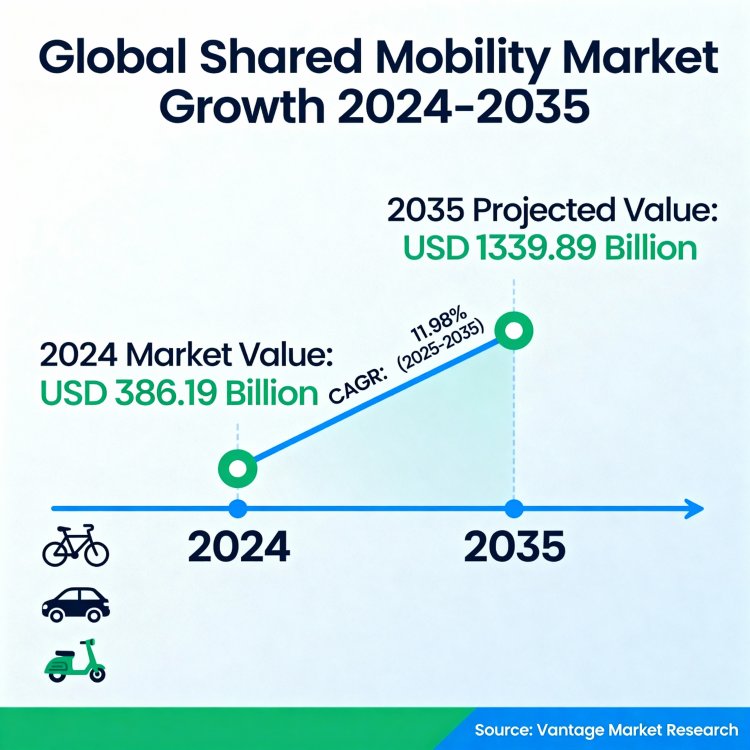
Global Shared Mobility Market: 2024 Outlook and 2035 Forecast
The Shared Mobility Market is undergoing a transformative shift, driven by changing consumer preferences, rapid urbanization, and the rising costs of private vehicle ownership. Shared mobility encompasses ride-hailing, car-sharing, bike-sharing, and micro-mobility services, offering affordable and sustainable alternatives to traditional transport. With governments emphasizing smart city initiatives and sustainability goals, coupled with increasing adoption of electric and connected vehicles, the industry is experiencing unprecedented growth.
To learn more about the global trends impacting the future of Shared Mobility Market research report, Download a PDF Sample
Key Takeaways
- Market Size & Growth: Valued at USD 386.19 billion in 2024, expected to soar to USD 1,339.89 billion by 2035, at a CAGR of 11.98%.
- Leading Region: Asia Pacific dominates in both volume and growth rate.
- Fastest-Growing Segment: Micro-mobility services (e-scooters, bikes) are gaining momentum.
- Market Drivers: Urbanization, rising vehicle ownership costs, traffic congestion, and smartphone penetration fuel the surge .
- Competitive Landscape: The market remains fragmented, with major players like Uber, Lyft, Didi, Grab, Ola, Zipcar, Lime, and Bird.
- Current Development: In 2025, Lyft acquired FreeNow for €175 million, expanding into nine European countries and bolstering its international footprint.
Premium Insights
Shared mobility is evolving with the integration of electric vehicles (EVs), on-demand AI-powered services, and seamless app-based booking, tracking, and payments. Rising urban populations and rising costs of private vehicle ownership are pushing consumers towards more sustainable and flexible mobility modes.
Forecasts show a remarkable growth trajectory—from USD 386.19 billion in 2024 to USD 1,339.89 billion by 2035, achieving a CAGR of 11.98% during 2025–2035.
The shared mobility landscape is highly competitive, with global giants (Uber, Didi, Lyft, Grab) sharing space with regional leaders (Ola, Zipcar, Lime, Bird). While ride-hailing dominates, micro-mobility and carsharing are gaining traction. Tech innovations and local regulations further shape competitive dynamics.
For Shared Mobility Market Research Report and updates detailed: View Full Report Now!
Service Models Insights
The Shared Mobility Market by service models includes ride-hailing, car-sharing, bike-sharing, and scooter-sharing. Ride-hailing dominates due to convenience and widespread urban adoption. Car-sharing appeals to users seeking cost-effective alternatives to ownership, reducing parking and maintenance expenses. Bike-sharing and scooter-sharing are gaining traction for short urban commutes, driven by micro-mobility trends and sustainability initiatives. These models enhance accessibility, reduce traffic congestion, and support eco-friendly transport, aligning with government-backed smart city projects and consumer demand for flexible, on-demand mobility services.
Vehicles Insights
Vehicle segmentation comprises cars, two-wheelers, and micro-mobility options such as e-bikes and e-scooters. Cars remain the largest segment, fueled by demand for ride-hailing and car-sharing services in metropolitan regions. Two-wheelers, especially motorbikes, dominate in densely populated Asian markets due to affordability and agility in traffic. Micro-mobility options are rapidly expanding worldwide, driven by eco-friendly commuting, last-mile connectivity needs, and government policies promoting sustainable transportation. Each vehicle type contributes uniquely, catering to diverse urban mobility requirements while reducing dependence on privately owned vehicles.
Regional Insights
North America Shared Mobility Market Trends
North America is a key market for shared mobility, driven by the high adoption of ride-hailing services like Uber and Lyft. Rising urban congestion, increasing fuel costs, and changing consumer preferences toward flexible transport options support market growth. Government support for EV adoption and investments in micro-mobility infrastructure are accelerating demand. Additionally, collaborations between automakers and shared mobility providers are shaping the market landscape, making North America a hub for innovation in sustainable and connected urban mobility solutions.
Europe Shared Mobility Market Trends
Europe leads in sustainability-driven shared mobility initiatives, supported by strict emission regulations and widespread adoption of EVs in fleet services. Countries like Germany, France, and the UK are expanding car-sharing, bike-sharing, and scooter-sharing networks to reduce urban congestion and pollution. EU funding for smart city projects and green transportation is boosting market growth. Consumers’ increasing preference for affordable, eco-friendly commuting options and strong integration of digital platforms are driving the rapid adoption of shared mobility solutions across European cities.
Asia Pacific Shared Mobility Market Trends
Asia Pacific is the fastest-growing region in the shared mobility market, driven by rapid urbanization, growing middle-class populations, and high smartphone penetration. China and India dominate the ride-hailing and two-wheeler sharing segments, with strong government support for EV-based mobility. Rising e-commerce demand also supports last-mile delivery services powered by shared mobility fleets. Infrastructure expansion, strategic partnerships between global and local players, and affordability are fueling adoption, positioning Asia Pacific as a global leader in mobility innovation and growth.
Latin America Shared Mobility Market Trends
Shared mobility adoption in Latin America is expanding steadily, led by countries like Brazil, Mexico, and Chile. Rising urbanization, traffic congestion, and high car ownership costs are pushing consumers toward ride-hailing and car-sharing services. Bike-sharing and scooter-sharing initiatives are growing in urban centers as eco-friendly solutions. Economic challenges and infrastructure gaps present hurdles, yet ongoing digitalization and mobile payment adoption support growth. Partnerships between local startups and international mobility providers are creating opportunities for service expansion in the region.
Middle East & Africa Shared Mobility Market Trends
The Middle East & Africa region is witnessing growing shared mobility adoption, particularly in the UAE, Saudi Arabia, and South Africa. Government-led smart city initiatives and investments in modern transportation infrastructure are driving growth. Ride-hailing and car-sharing are gaining traction among urban populations, while micro-mobility services are gradually entering metropolitan markets. Rising tourism, combined with increasing demand for affordable and flexible mobility, supports adoption. However, regulatory frameworks and limited infrastructure in some areas pose challenges to widespread expansion.
Top Key Companies:
Major players include Uber, Lyft, Didi Chuxing, Grab, Ola, Lime, Bird, Zipcar, Turo, and BlaBlaCar. These platforms lead by offering ride-hailing, car-sharing, micro-mobility, and alternative transport models across global and regional markets.
Recent Developments
- Lyft’s Acquisition of FreeNow (2025): Lyft expanded into Europe by acquiring FreeNow (formerly Ride, co-founded by BMW and Mercedes-Benz) for €175 million. Operating across nine countries, FreeNow provides taxis, e-scooters, and car-sharing. This deal doubles Lyft’s potential market and strengthens its competitive position against Uber.
Shared Mobility Market Future Scope
Vantage Market Research provides a holistic analysis, covering market size, growth forecasts, segmentation by service model, vehicle type, and region; competitive landscapes; market dynamics; and recent developments—empowering stakeholders to make informed strategic decisions.
Market Dynamics
Driver:
Rapid urbanization, coupled with rising costs of owning and maintaining private vehicles, is a key driver of the shared mobility market. Consumers are increasingly seeking affordable and convenient alternatives like ride-hailing, car-sharing, and micro-mobility services. Traffic congestion, parking challenges, and growing environmental awareness further encourage shared mobility adoption. Governments worldwide are supporting sustainable transport initiatives, promoting EV integration, and incentivizing shared mobility solutions, making them an attractive choice for individuals and businesses seeking cost-effective and eco-friendly commuting options.
Restraint:
The shared mobility market faces restraints from diverse regulatory and legal frameworks across regions. Ride-hailing and car-sharing companies often encounter compliance issues related to driver licensing, insurance, safety standards, and labor classifications. Inconsistent regulations can delay market expansion, particularly in emerging markets. Additionally, disputes between traditional taxi operators and ride-hailing services create resistance in certain regions. These challenges increase operational costs and require companies to adapt their business models, hindering seamless adoption and scaling of shared mobility services globally.
Opportunity:
The growing shift toward electric vehicles (EVs) and government-backed smart city initiatives offers immense opportunities for the shared mobility market. Integration of EV fleets reduces operational costs and supports sustainability goals, while digital platforms enable seamless, app-based booking and payments. Smart city projects worldwide are investing in micro-mobility infrastructure, including charging stations, dedicated lanes, and parking zones. These initiatives enhance adoption rates, attract investments, and create partnerships between automakers, technology providers, and shared mobility operators, driving long-term market growth.
Challenge:
Maintaining profitability remains a major challenge for shared mobility providers due to high competition, fluctuating demand, and heavy investment requirements. Subsidies and discounts used to attract customers often strain financial sustainability. Operational costs, including vehicle maintenance, fuel, insurance, and compliance, further limit margins. Seasonal and regional demand variations also affect revenue consistency. To overcome this, companies must innovate with dynamic pricing, expand service portfolios, and leverage advanced analytics, ensuring long-term viability in an increasingly competitive shared mobility landscape.
Global Shared Mobility Market Segmentation
- By Service Model: Ride-hailing, Car-sharing, Bike-sharing, Scooter-sharing, Micro-transit, Others.
- Vehicle Type: Passenger Cars, Two-wheelers, LCVs, EVs, Autonomous Vehicles.
- Region: North America, Europe, Asia Pacific, Latin America, Middle East & Africa.
Frequently Asked Questions
- What is the projected market size by 2035?
Forecasted to reach USD 1,339.89 billion by 2035.
- What is the expected CAGR from 2025 to 2035?
11.98% compound annual growth rate.
- Which region leads in market share and growth?
Asia Pacific is both the largest and fastest-growing region.
- What are primary drivers of growth?
Key drivers include urbanization, escalating vehicle ownership costs, traffic congestion, and smartphone penetration.
- What significant recent development has occurred?
In 2025, Lyft acquired FreeNow to expand across Europe, strengthening its competitive reach